
Epoxy Is Quietly Breaking Quantum Tech—Here’s the Upgrade
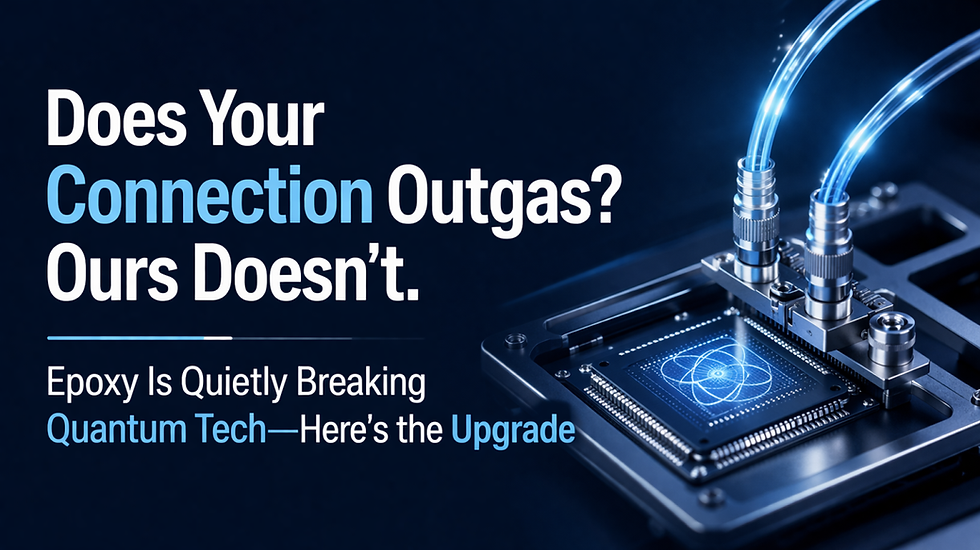
Quantum systems are reaching performance levels where even tiny material flaws matter. The interface between fiber and chip is no longer just a connection, it’s the difference between stability and drift.
A Reality Check for Quantum Engineers
Quantum systems don’t fail loudly, they drift. And more often than not, that drift starts at the fiber-to-chip interface.
If your interconnect relies on epoxy, you are introducing:
●Outgassing, epoxy releases trapped gases over time, increasing contamination risk and limiting achievable vacuum levels (up to 100× higher outgassing than metals)
●Mechanical instability at cryogenic temperatures
●Alignment drift under thermal cycling
These are not edge-case issues. They are built into the material system.
The real question is no longer if epoxy fails but whether your system can tolerate when it does.
The Shift: From Adhesives to Structural Bonding
Quantum hardware has evolved beyond the limitations of traditional packaging. The industry is moving toward:
●Adhesion-free bonding
●Inorganic interfaces
●Permanent structural stability
This is not incremental improvement, it is a necessary upgrade.
PIX-Attach: Built for Quantum-Grade Integration
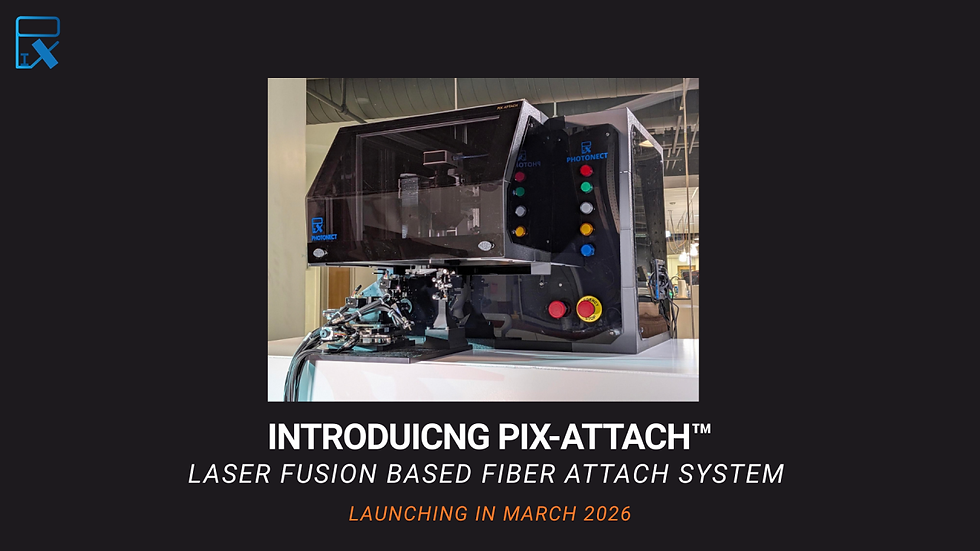
Photonect’s PIX-Attach is engineered to eliminates the root causes of instability by replacing adhesives with laser-based glass-to-glass fusion bonding.
1.Zero-Outgassing Architecture
PIX-Attach removes epoxy entirely.
●No organic materials
●No trapped volatiles
●No long-term contamination
2.Cryogenic & Thermal Cycling Stability
PIX-Attach creates a direct glass-to-glass fusion bond
●Stable from -196°C to 220°C
●No polymer shrinkage or creep
●No delamination under thermal cycling
3.Sub-Micron Precision That Holds
PIX-Attach enables precision alignment followed by permanent fixation.
●Packaging loss: ±0.2 dB
●Coupling loss: <0.5–0.6 dB per facet
4.Speed: From Minutes to Seconds
Traditional fiber attach methods can take ~10 minutes per attachment. PIX-Attach achieves:
●<1 second attach time
That’s a >10× improvement in process speed enabling true scalability:
●Up to 60 units/hour with active alignment
●Up to 720 units/hour with passive alignment
Unlike traditional systems, this does not come at the cost of precision
5.Retrofit-Ready Integration
PIX-Attach is designed to integrate into existing systems:
●Compatible with active and passive alignment setups
●Supports SM, PM, High NA and Custom fibers
Conclusion
Epoxy-based interconnects were sufficient for earlier photonics systems.
They are not sufficient for quantum systems.
Quantum hardware demands:
●Zero-outgassing materials
●Cryogenic stability
●Permanent alignment integrity
PIX-Attach delivers all three through a fundamentally different approach.
If your connection outgasses, it’s a liability If it doesn’t, it’s PIX-Attach.
Sources
1.Photonect Technology Brochure
2.Gupta et al., Outgassing from epoxy resins, Vacuum Journal (ScienceDirect)
3.Hussein et al., Cryogenic behavior of epoxy materials, ScienceDirect
4.NASA Outgassing Database, Materials in Vacuum Systems
5.Acta Astronautica, Material behavior in space vacuum environments


What a fantastic breakdown of how epoxy is subtly revolutionizing quantum technology; I really appreciate you demystifying it so clearly. I actually went down a similar rabbit hole a few months ago, trying to grasp the fundamentals, and learned so much from various sources, but your explanation really tied it all together. It makes me wonder what true mastery of this area looks like for researchers. For me, the practical applications are what truly capture the imagination https://www.theguardian.com/australia-news/2025/jun/30/australian-influencers-warned-after-several-accounts-inadvertently-promote-offshore-bookmakers-ntwnfb I've been involved in some material science projects, and seeing how these advancements could translate into more robust and efficient systems is incredibly exciting. It’s not just theoretical; it feels like we're on the cusp of tangible improvements. I've already forwarded this…