
Co-Packaged Optics Is Redefining Interconnect Design

The rapid rise of AI, high-performance computing, and hyperscale data centers is forcing a fundamental rethink of how systems are built. Bandwidth demand is accelerating faster than traditional architectures were designed to handle, while power and thermal limits are tightening.
Data center traffic is growing at nearly 30% annually, creating a widening gap between demand and what current interconnect technologies can deliver. (Springer)
At the same time, global data center capacity demand is projected to more than triple by 2030, putting further strain on infrastructure. (Molex)
The takeaway is clear. Scaling is no longer about faster chips or incremental upgrades. It is about rethinking system architecture.
What Is Co-Packaged Optics (CPO)?
Co-Packaged Optics (CPO) is an architectural approach that integrates optical engines directly alongside switch ASICs on the same substrate.
Traditionally, optical transceivers sit at the edge of a system and connect through electrical traces. CPO removes that distance by bringing optics directly next to compute.
In simple terms:
Pluggables: optics at the edge
CPO: optics at the core
By shortening the electrical path between the chip and optics, CPO improves both efficiency and performance. (Corning)
This is not just a packaging upgrade. It changes how data moves through the system.

How CPO Works
A. Switching ASIC
The high-bandwidth chip (25.6T / 51.2T / 102.4T switches) sits at the center.
B. Optical Engines
Photonic modules are placed right next to the ASIC and include:
Photonic integrated circuits (SiPh, InP, SiN, or LiNbO₃)
Modulators
Detectors
Coupling interfaces (grating or edge couplers)
Sometimes integrated monitoring photodiodes
C. External Laser Source (ELS)
Instead of integrating lasers directly on the hot ASIC, CPO systems often use an external laser module.
The laser light is delivered over fiber into each optical engine.
D. Fiber Connectivity
Bundles of fibers enter the package and connect directly to the optical engines.
Two coupling methods exist:
Edge coupling (low loss, used in high-performance CPO systems)
Grating coupling (more alignment-friendly, but typically higher loss)
E. Thermal Management
ASICs operate at high temperature (~85–100°C).
Optical components prefer lower temperatures (<50°C).
CPO systems use:
Localized heat sinks
Cold plates
Thermal barriers to maintain stability across both domains.
Why CPO Is Gaining Momentum
CPO is gaining traction because it directly addresses the limits of existing architectures.
A.Electrical Interconnect Limits
Copper interconnects struggle at higher data rates. Signal integrity degrades over distance, and maintaining performance requires increasing power.
B.Power Consumption
As data rates rise, power consumption increases disproportionately. The interface between optics and switches is becoming a major contributor to system power. (IEEE ComSoc)
CPO can reduce optical power consumption by up to 65% compared to pluggable solutions, making it attractive for hyperscale deployments. (Nasdaq)
C.Bandwidth Density
AI systems are pushing beyond 100 Tb/s per node. Traditional electrical architectures are not built to support this efficiently. (Siemens)
D.Latency and Distance
Electrical links lose efficiency with distance, increasing latency and energy per bit. CPO reduces this by minimizing the electrical path.
How CPO Changes System Architecture
CPO is not just about replacing one component. It changes how systems are designed from the ground up.
From Board-Level to Package-Level Integration
Signals no longer need to travel across the board to reach optics. Optical I/O is embedded within the package.
Blurring System Boundaries
Compute, optics, and packaging are no longer separate domains. They are tightly integrated and require co-design.
Earlier Shift to Optical Pathways
Electrical interconnects are no longer the primary carriers at high speeds. Optical transmission begins much closer to the chip.
CPO is not a component innovation. It is an architectural shift that reshapes system design. (arXiv)
Industry leaders are already treating CPO as a core infrastructure shift rather than an experimental technology.
In NVIDIA’s technical discussion on scaling AI factories, the company highlights that modern AI infrastructure is transitioning from traditional server networks to network-defined AI factories, where bandwidth, latency, and power efficiency are dictated by optical networking design rather than electrical interconnects.
Why Interconnect Design Now Matters More Than Ever
CPO is often discussed as a photonics innovation, but its impact reaches directly into the interconnect layer.
As optics move closer to the chip:
Fiber routing becomes denser
Interfaces move inside the system boundary
Alignment tolerances become tighter
Interconnects are no longer peripheral. They are central to system performance.
System efficiency now depends not only on component design, but on how effectively fiber is integrated across interfaces.
The Shift Toward Precision Fiber Integration
CPO introduces new requirements that traditional interconnect approaches were not designed to handle:
High-precision fiber alignment
Repeatable and scalable attachment processes
Stability under thermal and mechanical stress
These requirements apply across multiple levels:
Photonic packages
Sub-assemblies
Interconnect platforms
The focus is shifting from what connects to how it connects.
Where Photonect Fits In
Photonect operates at the intersection of photonics and interconnect integration.
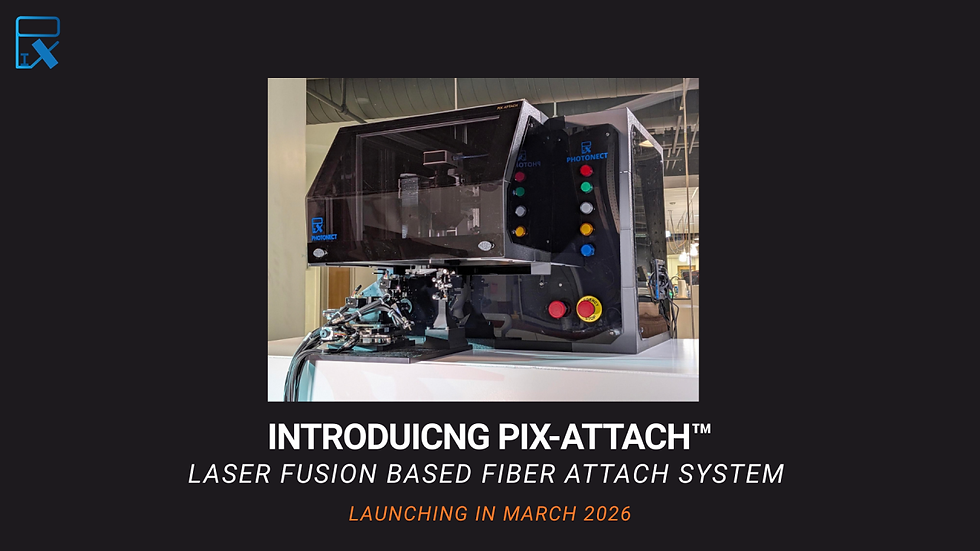
By enabling laser-based, adhesion-free fiber attachment, Photonect supports:
High-precision alignment for consistent optical performance
Fast and repeatable processes for manufacturing scale
Flexibility across multiple integration points, including fiber-to-chip and fiber-to-interconnect systems
Rather than focusing on a single interface, Photonect aligns with the broader need for precision fiber integration across modern architectures.
Photonect is not just adapting to CPO. It is enabling the integration workflows that CPO requires.

Final Thoughts: CPO Is an Interconnect Opportunity
Co-Packaged Optics represents a major shift in how modern systems are designed.
It brings optics closer to compute, but it also increases the importance of how systems are connected at every level.
CPO may begin as a photonics innovation, but its long-term impact will depend on how the interconnect layer evolves alongside it.
The future of high-performance systems will not just depend on moving data faster. It will depend on how seamlessly every layer of the system connects.
Sources

This article really hit home for me, and I'm so glad I stumbled upon it. As someone who has been working with co-packaged optics for a while now, I can confirm that this post is absolutely on point. It manages to make a complex topic feel both incredibly important for the future of interconnect design and surprisingly approachable, which is a rare feat. I particularly appreciated how you broke down the core concepts https://www.osko.com.au/ It's also worth adding that co-packaged optics exhibit distinct seasonal patterns, much like many other tech sectors, which can influence deployment and demand. This nuance adds another layer to understanding its market dynamics. The more I reflect on your analysis, the more I find myself in…