
What Happens Between the Fiber and the Device Matters More Than Ever!

The optical industry has spent decades pushing the boundaries of what individual components can achieve. Photonic integrated circuits (PICs) are becoming more powerful. Optical transceivers have progressed from 100G to 400G, 800G, and toward 1.6T solutions. Co-Packaged Optics (CPO) is changing how optical engines interact with switching silicon. AI workloads are accelerating the demand for faster, more efficient data movement. But as optical systems continue to evolve, an important question is becoming increasingly difficult to ignore:
What happens between the fiber and the device?
The industry has successfully improved many of the components that generate, process, and transmit optical signals. However, the performance of the overall system increasingly depends on something much less visible: the precision, reliability, and scalability of the connections between those components.
At Photonect, we believe the next major challenge in optical interconnects is not only about moving more data. It is about connecting optical components with the precision required to support the next generation of systems.
Optical Scaling Is Changing the Role of Interconnects
For years, advances in computing followed a familiar path: improve the performance of individual components.
Faster processors.
More powerful accelerators.
Higher bandwidth memory.
More efficient optical engines.
However, AI infrastructure is changing how systems are designed. Modern AI workloads increasingly rely on distributed architectures where thousands of processors must communicate efficiently. This shift is driving two important trends: Scale Up and Scale Out
The Hidden Challenge: Fiber-to-Interconnect Integration
When discussing optical systems, conversations often focus on the performance of individual components:
Lasers
Photonic integrated circuits
Optical engines
Switch ASICs
However, every optical system depends on a critical step that happens before the system can operate:
The integration of optical fibers with the interconnect structures that carry the signal.
This fiber-to-interconnect connection can take many forms:
Fiber-to-connector assemblies
Fiber array unit (FAU) integration
Fiber-to-glass structures
Fiber-to-PIC
Although these applications may look different, they share a common engineering challenge:
The optical fiber must be positioned, attached, and maintained with extremely high precision.
Even small variations can impact:
Insertion loss
Return loss
Coupling efficiency
Long-term reliability
Manufacturing yield
As optical budgets become tighter, these small differences become increasingly important.
Why Fiber-to-Glass Integration Is Becoming More Important
One major trend emerging across optical manufacturing is the increasing use of glass-based interfaces. Historically, discussions around photonic integration often focused on fiber-to-chip attachment. However, many next-generation optical architectures rely on intermediate glass structures that enable more scalable and precise integration.
Examples include:
Fiber array units
Glass interposers
Ferrule-based assemblies
Beam expansion structures
Optical coupling components
Why glass? Because glass provides several advantages:
Excellent dimensional stability
Low thermal expansion
High optical compatibility
Precision manufacturing capability
As optical interconnect density increases, glass-based structures provide a platform for maintaining alignment and performance across increasingly complex systems.
The industry is moving toward a future where fiber-to-glass integration becomes just as important as fiber-to-chip integration.

Every Connection Is a Potential Performance Challenge
An optical link is only as strong as its connections. Every fiber-to-interconnect interface introduces engineering considerations.
Alignment
Optical coupling requires extremely precise positioning. A small misalignment can reduce the amount of light transferred between components, increasing optical losses. As data rates increase, alignment tolerances become tighter.
The challenge is not achieving precision once. The challenge is achieving the same precision repeatedly at manufacturing scale.
Cleanliness and Contamination
For optical connectors and fiber assemblies, cleanliness has always been critical.
A microscopic particle of dust on a fiber end face can affect optical performance by creating:
Additional insertion loss
Increased back reflection
Signal degradation
As connector density increases and optical systems become more complex, contamination control becomes increasingly important.
In hyperscale environments, a small issue multiplied across thousands or millions of optical connections can become a significant reliability concern.
This is why next-generation optical manufacturing must consider not only how components are connected, but also how those connections remain stable over time making epoxy not the best fit.
Rethinking Traditional Fiber Attachment
Traditional fiber attachment approaches have enabled decades of optical innovation. However, as performance requirements increase, new challenges are emerging.
Conventional adhesive-based attachment methods can introduce considerations such as:
Material aging
Thermal expansion mismatch
Process variability
Long-term stability
Laser-based glass-to-glass attachment represents one emerging pathway toward more precise and stable fiber integration.
Photonect's Advantage
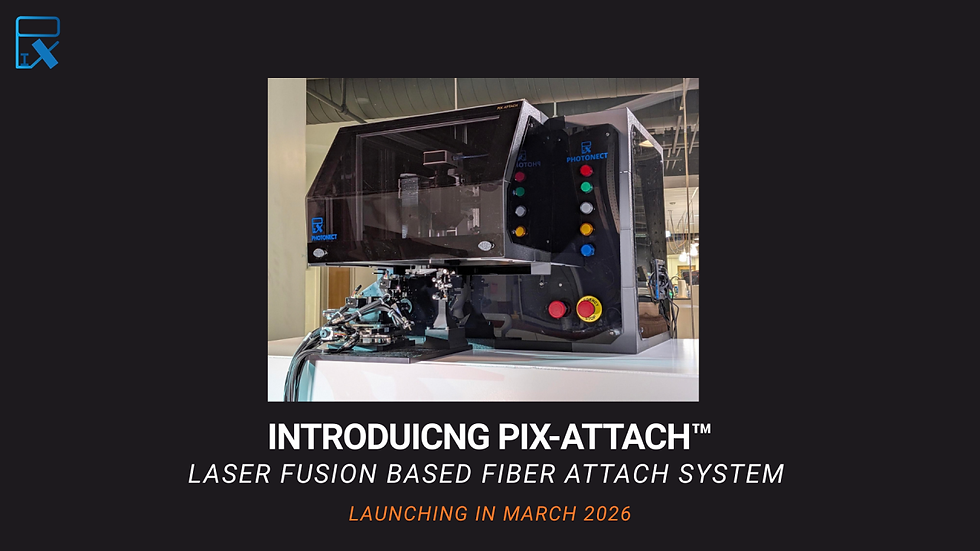
Photonect is focused on enabling the next generation of optical interconnect manufacturing through precision fiber integration.
Our laser-based, adhesion-free attachment technology addresses a fundamental industry challenge:
How do we create reliable, repeatable, and scalable connections between optical fibers and interconnect structures?
As optical systems become more complex, the ability to precisely integrate fibers with glass-based structures will become increasingly important.
Photonect's technology is designed around this future: enabling manufacturers to build optical connections that meet the precision and scalability requirements of next-generation systems.

The Future of Optical Interconnects Will Be Defined by Connections
The optical industry has always been driven by breakthroughs inside devices.
Better chips.
Better lasers.
Better photonic architectures.
Those innovations will continue. But the next generation of optical systems will also depend on something equally important:
The connections between those components.
As AI infrastructure scales up and scales out, optical interconnects will require manufacturing approaches that deliver precision, reliability, and scalability at unprecedented levels.
The future of optical communication will not only depend on how fast we can move light. It will depend on how precisely we can connect it.
Sources & References
Optical Internetworking Forum (OIF) – 800G and 1.6T optical interconnect standards and industry requirements
IEEE Communications Society – Co-Packaged Optics and next-generation data center networking challenges
Corning Incorporated – Optical connectivity trends, fiber infrastructure, and co-packaged optics developments
LightCounting Market Research – High-speed optical transceiver market trends and 800G/1.6T adoption
Dell’Oro Group – Data center networking and optical transport market analysis
Molex – Data center connectivity trends and optical interconnect scaling challenges
NVIDIA – AI factory architecture and accelerated computing infrastructure discussions
US Conec – High-density optical connector technologies and MPO/MTP connectivity solutions

Comments